Our opinion
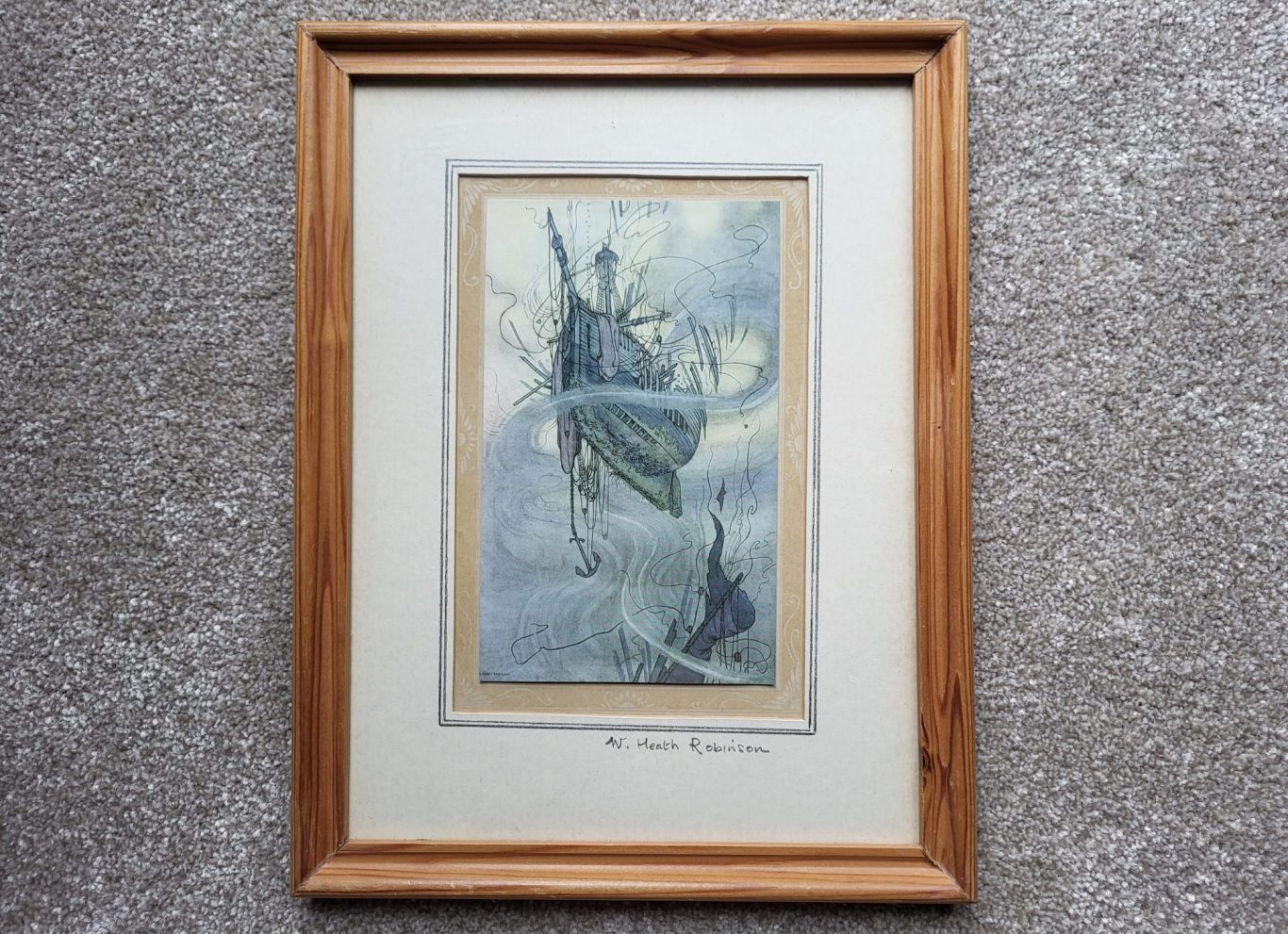
This is a charming print. Produced to illustrate Rudyard Kipling's book 'A Song of the English' first published in 1893.
W Heath Robinson
About W Heath Robinson
William Heath Robinson was born in Hornsey Rise, London, on 31 May 1872[4] into a family of artists in Stroud Green, Finsbury Park, North London. His grandfather Thomas, his father Thomas Robinson (1838–1902) and brothers Thomas Heath Robinson (1869–1954) and Charles Robinson (1870–1937) all worked as illustrators. His uncle Charles was an illustrator for The Illustrated London News.[5]
His early career involved illustrating books – among others: Hans Christian Andersen's Danish Fairy Tales and Legends (1897), The Arabian Nights (1899), Tales from Shakespeare (1902), Gargantua and Pantagruel (1904),[6] Twelfth Night (1908), Andersen's Fairy Tales (1913), A Midsummer Night's Dream (1914), Charles Kingsley's The Water-Babies (1915) and Walter de la Mare's Peacock Pie (1916). Robinson was one of the leading illustrators selected by Percy Bradshaw for inclusion in his The Art of the Illustrator (1917–1918) which presented a separate portfolio for each of twenty illustrators.[note 1]
Robinson served as a consultant at the Percy Bradshaw's The Press Art School, a school teaching painting, drawing, and illustration by correspondence. The consultants commented on the work submitted by the students.[9]: 32 In the course of his work, Robinson wrote and illustrated three children's books, The Adventures of Uncle Lubin (1902), Bill the Minder (1912) and Peter Quip in Search of a Friend (1922). Uncle Lubin is regarded as the start of his career in the depiction of unlikely machines.
During the First World War, he drew large numbers of cartoons, depicting ever-more-unlikely secret weapons being used by the combatants, and the American Expeditionary Force in France.[10]
After the war, his work was included in the painting event in the art competition at the 1932 Summer Olympics.[11]
Testing Golf Drivers, a typical "Heath Robinson contraption".
As well as producing a steady stream of humorous drawings for magazines and advertisements, in 1934 he published a collection of his favourites as Absurdities, such as:
- "The Wart Chair. A simple apparatus for removing a wart from the top of the head"
- "Resuscitating stale railway scones for redistribution at the station buffets"
- "The multimovement tabby silencer", which automatically threw water at serenading cats
Most of his cartoons have since been reprinted many times in multiple collections.
The Painting
From 'The Song of the English' by Kipling, a framed print, signed, size 19x12cm
On Sale for £95
We can arrange delivery or you can collect from our Orpington, Kent office
If you have any questions, please don't hesitate to contact us
There is only one available